Watering Strategy for Mid-Michigan Lawns in July and August: Push Through or Let It Sleep?
Keast Lawn & Snow • July 2026 • East Lansing, MI
The Short Answer
There are two valid watering strategies for cool-season lawns in mid-Michigan during July and August. Push through means committing to enough irrigation to keep the lawn actively growing all summer — roughly an inch to an inch and a quarter of water per week — producing a green lawn through August at meaningful water cost. Let it sleep means watering only enough to keep the crowns alive (about a third of an inch every two to three weeks during dry stretches) and accepting a brown summer in exchange for a much lower water bill and a perfectly healthy lawn that wakes back up in September.
The wrong move is the third option most homeowners default to: light daily watering that does not keep the lawn green and actively prevents the crowns from going dormant. Pick one strategy and commit. The mixed approach is what causes most July damage.
How Cool-Season Grass Actually Handles Summer
Kentucky bluegrass, perennial ryegrass, tall fescue, and fine fescue are not built for week after week of 85 to 90 degree daytime highs. When conditions exceed their preferred range, healthy plants pull resources from the blades down into the crowns and roots, shut down most photosynthesis, and wait out the heat. The above-ground tissue browns. The crown stays alive. When temperatures drop in late August or September, the plant pushes new growth from the crown and the lawn greens up.
This dormancy response is a feature, not a bug. A healthy mid-Michigan lawn can stay dormant for six to eight weeks and bounce back fully. The damage threshold is when dormancy extends beyond about ten weeks without any water at all — at that point crowns start dying and recovery becomes patchy. What breaks the system is partial watering: a short cycle every other day keeps the surface wet, prevents the plant from fully going dormant, but does not deliver enough water for actual growth. The plant burns energy trying to stay active without the resources it needs, and the crowns weaken instead of strengthen.
Strategy One: Push Through
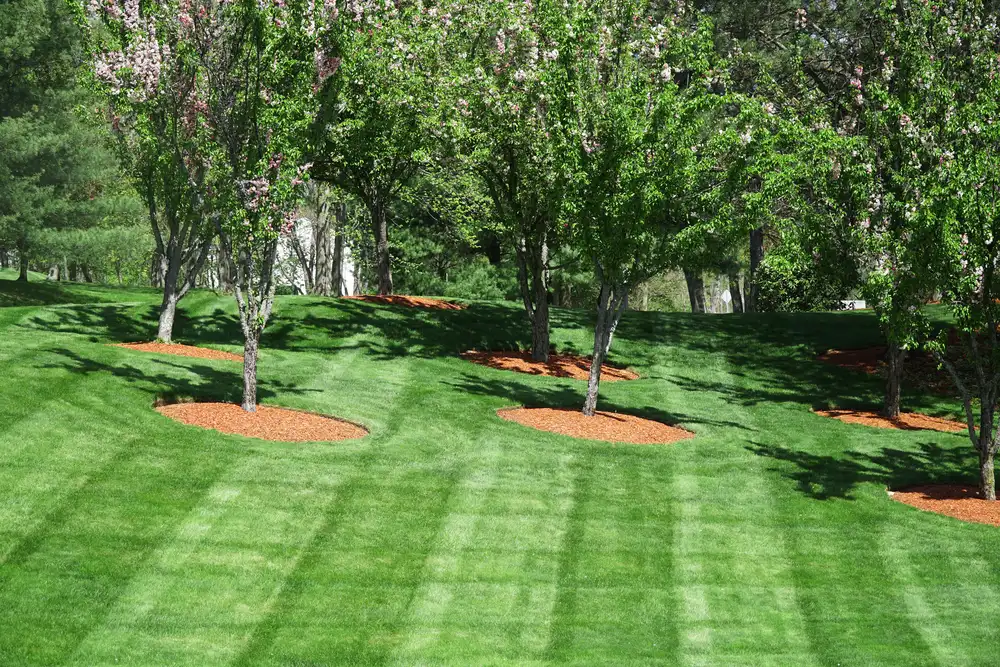
The push-through strategy keeps the lawn green and growing all summer. That requires roughly an inch to an inch and a quarter of water per week during 85-plus degree stretches, delivered in two or three deep cycles per week in early morning (4–8 am), each wetting the top four to six inches of soil.
What It Looks Like
Lawn stays mostly green, mowing continues weekly or bi-weekly at 3.5–4 inches, lawn responds well to light slow-release fertility in mid-August, and enters fall already strong. Push-through lawns are also more resilient against grub damage because the root system stays active.
What It Costs
A typical East Lansing residential lawn (7,000–12,000 sq ft) runs about $30–$80 per month in additional water charges. Irrigation heads need monthly checks. Push-through lawns can be more vulnerable to fungal disease (brown patch, pythium, dollar spot) during hot humid weather and may need preventive fungicide in August.
Strategy Two: Let It Sleep
The let-it-sleep strategy accepts a brown summer in exchange for a much lower water bill, less mowing, less disease pressure, and a lawn doing exactly what cool-season grass evolved to do. This is not the same as ignoring the lawn. Dormancy support watering means applying about a third of an inch in a single deep cycle during extended dry periods (3+ weeks with less than a quarter inch of rainfall) to rehydrate the crowns without waking the lawn up.
What It Looks Like
Lawn turns straw colored across most exposures, with greener patches in shaded areas. Mowing happens once every three to four weeks. Reduce foot traffic on dormant turf — brittle blades break and crowns can be crushed. No fertilizer during dormancy.
What It Saves
Often $200–$400 across July and August on a typical residential property, plus reduced mowing time, no fertilizer cost, lower fungicide pressure (no active tissue means much less disease vulnerability), and reduced irrigation system wear. The tradeoff is appearance — the lawn looks brown from mid-July through late August.
The Third Option That Damages Lawns
Most homeowners do neither strategy cleanly. A daily 10–15 minute cycle delivers maybe a tenth of an inch of water per day — enough to wet the surface and prevent dormancy, but nowhere near enough to maintain active growth in 85-plus degree weather.
The result: the lawn cannot go dormant because the surface keeps getting wet, and it cannot maintain active growth because there is not enough total water. Plants burn through their crown reserves, shallow roots develop, and disease pressure rises. The daily light cycle is the single most damaging watering pattern you can apply to a mid-Michigan lawn in July and August.
Either water deeply two or three times a week, or back off and let the lawn sleep. Anywhere in between is worse than either commitment.
How to Pick Your Strategy
Choose Push-Through When…
• You have a functioning in-ground irrigation system with reasonable coverage • Appearance through summer is a priority • The property is being shown or used heavily • The lawn is under three years old (new lawns should always be watered through summer) • The lawn has already been weakened by spring damage, disease, or grub feeding • The property has recently been seeded or sodded
Choose Let-It-Sleep When…
• There is no irrigation system or it has serious coverage issues • You are comfortable with a brown summer • Budget tightness makes the water bill matter • The soil is poor and shallow watering would encourage worse root systems • The lawn is older and has consistently struggled with disease under irrigation
What About a Middle Path?
There is one half-measure that works: strategic push-through. Push through during the most visible months (May, June, September, October) and let the lawn sleep through the deepest heat (mid-July through mid-August). That cuts irrigation costs about in half, lets the lawn dodge the worst disease window, and keeps the property looking good during the months when most people are actually on the grass.
The transition from active to dormant must be deliberate — reduce watering gradually over about two weeks to let the lawn shift down without shocking the crowns. The transition back from dormant to active in late August follows the same gradual approach. Done well, strategic push-through is a reasonable middle path. Done poorly (light watering all summer), it is the same damaging mixed approach described above.
Talk Through the Right Strategy for Your Lawn
If you want help thinking through which strategy fits your East Lansing area lawn, or want a coverage check on your irrigation system before committing to push-through, we are glad to walk the property and talk through the tradeoffs. We serve East Lansing, Lansing, Okemos, Haslett, Williamston, Holt, DeWitt, and surrounding mid-Michigan communities.