

Short Answer: The lawns that look great after fall renovation are the ones whose owners made decisions in July, not the ones who called in late August trying to get on a packed September schedule. The July assessment is where we figure out what kind of renovation a lawn actually needs (aeration only, overseed, slit-seed, or full reset), how much seed it will take, what species blend fits the conditions, and what week of September the work needs to land on. Wait until the end of August and you are stuck with whatever date is still open, whatever species the supplier still has in stock, and a much harder germination window if the work gets pushed past late September. The renovation itself is a few hours of equipment time. The planning that decides whether it works is what happens in July.
Fall is the right window for renovation on every cool-season lawn in mid-Michigan. The soil is still warm enough to drive germination, the air is cooling so new seedlings do not cook, weed pressure is dropping, and the recovering grass has eight to ten weeks of growing weather before winter dormancy locks it in. Spring renovation works on paper but loses to summer heat before the new grass develops the root mass to handle it. Fall wins every time, but only if the work actually lands in the right window and uses the right inputs.
That second piece is what trips up most homeowners. The renovation gets booked in late August or early September. The scheduler shows up, runs the aerator across the lawn, spreads seed, and leaves. Three weeks later there are patches of new grass and large stretches where nothing came up. The owner blames the seed, the contractor, or the weather. The actual problem was that nobody walked the lawn in July to figure out what kind of renovation it needed and what would actually fix the underlying issue.
What a July Renovation Audit Actually Looks At
When we walk a property in July with renovation in mind, we are reading the lawn against four questions. What percent of the lawn is actually grass we want to keep? What is the soil doing? What is the irrigation situation? What is the realistic schedule between now and the first frost? Each of those answers changes what the right renovation looks like.
Percent of desirable grass. Walk the lawn and estimate what fraction is actually cool-season turf in reasonable shape versus weeds, dead crowns, bare soil, and thatch. A lawn that is 80 percent good grass with thin areas needs a different treatment than a lawn that is 40 percent grass and 60 percent weeds. The first one is an overseed candidate. The second one is closer to a full renovation. The cutoff we use is roughly 50 percent. Above that, we are amplifying what is already there. Below that, we are mostly starting over and the seed rate, soil prep, and weed control all change.
Soil. We pull a few plugs and look at the structure, the moisture, and the depth of any thatch layer. A thatch layer thicker than half an inch will block seed-to-soil contact and waste any overseed application. Compacted soil means new roots cannot dive deep and the lawn will struggle again next summer regardless of how good the seed is. A high or low pH (we run soil tests in mid summer when there is time to actually act on the results) means nutrients are not available to germinating grass even if you fertilize at seeding.
Irrigation. The single largest reason fall seeding fails on mid-Michigan lawns is inadequate watering during the germination window. New seed needs the top half inch of soil to stay consistently moist for 14 to 21 days. Without irrigation, that comes down to rainfall luck. With irrigation, it comes down to whether the system actually covers the seeded areas and whether the homeowner is willing to run short cycles three or four times a day for the first two weeks. The July audit is when we figure out whether the irrigation is up to the job or whether hand watering is in the plan.
Schedule. The seeding window for mid-Michigan runs from late August to about September 25 for the strongest results, with a softer window extending to October 5 or so. Beyond that the grass germinates but does not develop the root mass to survive winter. July planning means picking the actual week and putting the work on the calendar before the September schedule fills.
Three Levels of Renovation
Most properties fall into one of three categories. Knowing which one fits saves a lot of money and a lot of frustration.
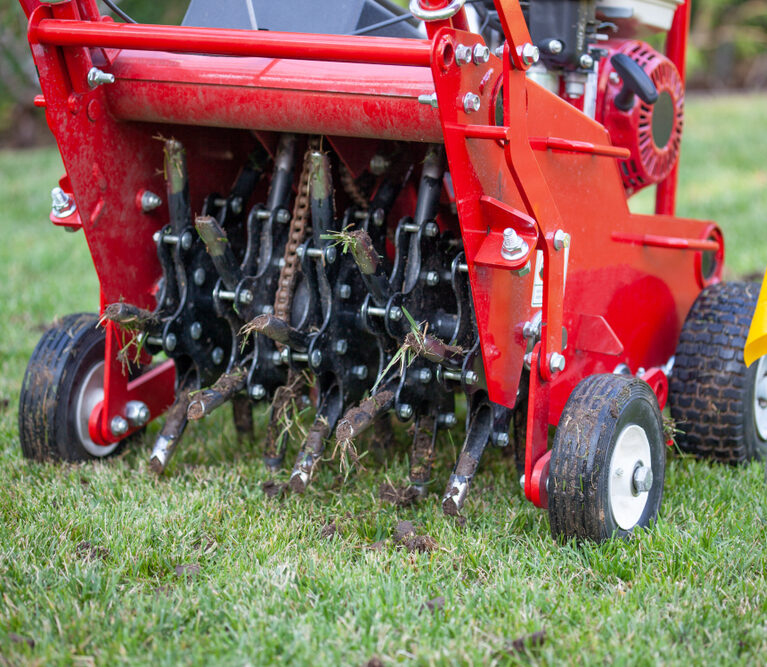
Level one is core aeration alone. This is the right choice for lawns that are 80 percent or more healthy grass, with thinning in heavy traffic areas and some compaction, but no major bare spots. Aeration pulls plugs of soil out, opens up the soil profile for water and air movement, and gives the existing grass room to spread. Aeration alone is the cheapest renovation and the right call when the underlying turf is mostly fine.
Level two is aeration plus overseed. This is for lawns in the 50 to 80 percent range, where there are thin areas and some bare spots but the existing grass is still doing most of the work. Aeration creates seed-to-soil contact in the holes the cores leave behind. The overseed adds new genetics and fills in thin areas. This is the most common renovation we run and the highest value per dollar for most properties.
Level three is slit-seeding or full renovation. Slit-seeding uses a machine that cuts grooves into the soil and drops seed directly into the slots. It produces dramatically better germination than broadcast overseeding when the existing canopy is thin enough that seed would otherwise sit on top of dead thatch. Full renovation involves killing what is there, tilling or scarifying the surface, amending the soil, and starting over. It is the right call when more than 50 percent of the lawn is weeds or dead, when the soil chemistry is badly off, or when the grass species in place are not what the homeowner actually wants.
Why July Is the Decision Point
A lot of the inputs that decide a successful renovation have to be lined up six to eight weeks before the work happens. Seed is the most common bottleneck. The premium Kentucky bluegrass blends, the elite turf-type tall fescue cultivars, and the disease-resistant ryegrass varieties are not sitting on the shelf at every supplier. By mid August the better seed has been spoken for and what is left is filler. Order in July, take delivery in August, and the right species are locked in.
Soil amendments are the next bottleneck. If a July soil test reveals that the lawn needs lime to correct pH, or sulfur to lower a high reading, or starter fertilizer with a specific N-P-K ratio, those products need to be applied in advance of seeding. Lime in particular takes weeks to actually move pH. Apply at seeding time and the new grass germinates into the same soil chemistry that failed the previous turf.
Weed control is the third one. If the lawn has heavy crabgrass pressure or perennial broadleaf issues, those need to be knocked back before seeding or they will outcompete the new grass during germination. Some weed control products have re-seed restrictions that require waiting four to twelve weeks after application before planting. Apply too late in August and you cannot seed in September.
Equipment scheduling is the fourth. Aerators, slit-seeders, and dethatchers are in heavy demand in September. The companies that own that equipment are working full days through the whole month. Lawns that get added to the schedule in late August often land on a date that is either too early (before night temperatures cool enough for germination) or too late (after the seed has a real chance at developing roots before frost).
The Audit Walk in More Detail
Here is what we actually do on a July renovation audit. We start with the same diagnostic walk we run on any July property visit (heat dormancy vs drought vs disease, soil probe checks, crown pulls in any brown patches). That tells us what the lawn is currently doing and what it can recover on its own versus what needs intervention.
Then we map the lawn into zones. Areas of fully healthy grass that need nothing. Areas of thin or stressed grass that will recover with cultural changes (water, mowing, modest fertility). Areas where the crowns are gone and the soil is going to be reseeded. Areas that need amendment work (lime, organic matter, sand for drainage in low spots). The map drives the seed quantity, the work order, and the cost estimate.
We pull soil samples from two or three representative spots. Lab results come back in about a week. That tells us pH, organic matter percentage, and any major nutrient deficiencies. If the soil is off, we can apply correctives in late July or early August so they have time to actually work before seeding.
We check the irrigation. If the homeowner has a system, we run a coverage test with catch cups and look for heads that are missing zones or overlapping wastefully. If there is no system, we plan around hand watering and either talk through the commitment that requires or scale the renovation to match what the owner is actually going to maintain.
Then we set the date. Late August through about September 20 is the sweet spot for most mid-Michigan years. Soil temperatures are still in the 60s, air temperatures are dropping into the 70s during the day and 50s at night, and there is enough growing weather ahead to get the new grass established before mid November. We book the actual day in July or early August so the work lands when it should.
What the Right Seed Looks Like
Seed selection is where a lot of renovations get quietly compromised. The contractor uses whatever blend they bought in bulk. The homeowner buys a box at the big-box store and hopes for the best. Neither approach is anchored in what the specific lawn actually needs.
For most mid-Michigan residential lawns we lean on a blend of Kentucky bluegrass for spreading capacity, turf-type tall fescue for drought and heat tolerance, and a small percentage of perennial ryegrass for fast germination and visual coverage during the establishment window. The exact ratio depends on sun exposure, irrigation availability, and the dominant grass already in place. A heavily shaded property gets more fine fescue. A high-traffic property gets more tall fescue. A premium lawn with reliable irrigation tilts toward more Kentucky bluegrass.
Cultivar matters as much as species. Modern Kentucky bluegrass cultivars resist summer patch and rust at levels far above the cheap unnamed bluegrass that shows up in discount blends. Turf-type tall fescue has been bred dramatically over the last two decades for finer blade, denser growth, and better disease resistance. Ordering by named cultivar from a turf supplier is part of what separates a real renovation from a hope-and-spray approach.
Cost Picture
Renovation costs in our area run roughly like this. Aeration only on a typical residential lawn is in the $200 to $400 range depending on size. Aeration plus overseed runs $400 to $900 with seed and a starter fertilizer included. Slit-seeding runs $500 to $1,200. Full renovation with soil prep and amendments is $1,500 to $3,500 or more depending on lot size and what the soil work requires. Skipping the audit and renovating blind costs nothing on paper but routinely turns into a redo the following fall, which doubles the actual cost.
What to Do Next
If you want a July audit on your East Lansing area lawn so you know exactly what your September renovation should look like (and so the right week is on the calendar before the schedule fills), we are glad to walk the property and put together a plan. We serve East Lansing, Lansing, Okemos, Haslett, Williamston, Holt, DeWitt, and surrounding mid-Michigan communities.
Call us at 517-894-5792 or visit keastlawn.com to schedule a renovation audit.