Why Mid-Michigan Lawns Need Fall Aeration More Than Most
Keast Lawn & Snow • September 2026 • Greater Lansing, MI • 7 min read
Short Answer: Core aeration pulls thousands of small plugs of soil out of your lawn so water, air, and nutrients can reach the root zone. It matters more in Greater Lansing than in many regions because our heavy soils compact readily and our freeze and thaw cycles work the ground hard every winter. September into early October is the window here: soil is still warm enough for quick recovery, the lawn is entering its strongest growth period of the year, and the holes double as ideal seed beds if you are overseeding. Leave the cores on the surface and let them break down naturally.
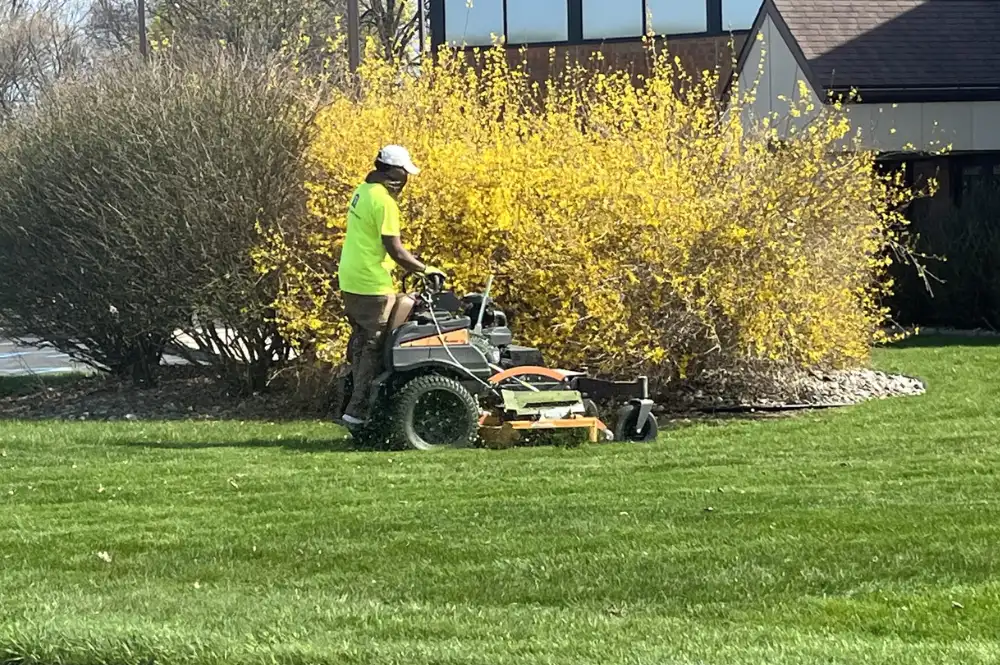
If your lawn thinned out over the summer, if water runs off instead of soaking in, or if the grass under the swing set has gone hard as pavement, you are looking at compaction. Most homeowners we talk to around Lansing assume the answer is more fertilizer. Usually the answer is air.
We walk a lot of properties this month, and compaction is the single most common limiting factor we find on lawns that are otherwise being cared for properly.
What Compaction Actually Does
Healthy soil is not solid. Roughly half its volume should be pore space, the gaps between soil particles that hold air and water. Roots need both. They need water to take up nutrients and they need oxygen to function at all, which is a fact that surprises people who think of roots as purely a plumbing system.
Compaction squeezes those pores closed. The soil particles press together, pore space collapses, and what remains is dense material that roots struggle to penetrate and water cannot enter. Rain that should soak in runs across the surface instead, taking fertilizer and topsoil with it.
The visible result is a lawn that looks tired no matter what you feed it. Thin turf, shallow roots, standing water after rain, poor drought tolerance the following summer, and weeds that tolerate compaction better than grass does moving in. Knotweed and plantain in particular are reliable indicators that the soil beneath them is tight.
Why This Region Is Harder on Soil
Three things make Greater Lansing lawns compact faster than lawns in gentler climates.
The first is what we are growing on. A great deal of Mid-Michigan sits on heavy soils with substantial clay content, which compacts more readily than sandy soil and holds that compaction longer.
The second is construction. In most subdivisions built in the last several decades, topsoil was stripped, heavy equipment ran across the subsoil for months, and then a thin layer of topsoil was spread back before sod went down. Under four inches of decent soil there is often a compacted layer that roots have never penetrated. Homeowners in newer neighborhoods are frequently caring for what amounts to a very shallow container garden.
The third is our winters. Repeated freezing and thawing shifts soil structure, and saturated soil in spring is highly vulnerable to compaction from any traffic across it. Every winter works your lawn's soil in ways a milder climate does not.
Add normal life on top of that, meaning kids, dogs, parked trailers, and mowing the same pattern every week, and compaction accumulates steadily.
Why Fall Rather Than Spring
Aeration helps in either season, but autumn is clearly better here.
Cool season grasses, meaning the fescue and bluegrass that make up most Lansing lawns, do their strongest root growth in autumn. Aerating when the plant is actively building roots means it capitalizes on the opened soil immediately.
Recovery conditions are also better. A lawn aerated in September knits back together during mild, moist weather with months of good growing conditions ahead. A lawn aerated in late spring is repairing itself heading into summer stress.
And if you are overseeding, which most Mid-Michigan lawns benefit from annually, the two jobs belong together. Aeration holes are perfect seed beds: protected from wind, in contact with real soil rather than thatch, and better at holding moisture. Seed dropped into aeration holes germinates at a far higher rate than seed broadcast onto an unaerated surface.
One important caution. If you are overseeding, do not apply a standard pre-emergent herbicide to that area, because it prevents grass seed from germinating just as effectively as it prevents weeds.
Core Aeration, Not Spike Aeration
This distinction matters and the equipment sold at hardware stores blurs it.
A core aerator removes plugs of soil and deposits them on the surface. Removing material creates space, which is the entire point.
Spike aerators, including the strap on lawn sandals, push a solid spike into the ground. Nothing is removed. The soil the spike displaces has to go somewhere, and it goes sideways, which compresses the soil immediately around each hole. On already compacted clay you can make the problem slightly worse.
If someone offers you aeration, ask whether they pull cores. The answer should be yes.
What to Expect Afterward
Your lawn will look untidy for a couple of weeks. The surface will be covered in soil plugs roughly the size of a finger joint, and there is no getting around the fact that it looks worse before it looks better.
Leave them. This is the most common instinct we have to talk people out of. Those cores contain soil and beneficial microorganisms, and as rain and mowing break them down over two or three weeks that material works back into the thatch layer and helps decompose it. Raking them up throws away a meaningful part of the benefit and adds hours of unnecessary work.
Water afterward, particularly if you seeded. Expect to see improvement in root depth and water infiltration by the following spring rather than within days. Aeration is not a treatment with a visible immediate effect, which is exactly why it gets skipped.
Aeration Is Not Dethatching
These two get confused constantly, and buying the wrong one is a waste of a season.
Thatch is the layer of dead and living stems and roots that sits between the green grass and the soil surface. A thin layer, under about half an inch, is healthy and acts as insulation. A thick layer is a problem, because water and fertilizer sit in it rather than reaching soil, and roots begin growing in the thatch itself where they are far more vulnerable to drought and cold.
Dethatching, sometimes called power raking, uses blades to tear that layer out. It is aggressive, it makes a substantial mess, and the lawn needs real recovery time afterward.
Aeration addresses compaction, and it helps thatch indirectly, because the soil cores deposited on the surface introduce microorganisms that speed decomposition of the thatch layer over time.
Most Mid-Michigan lawns need aeration. Considerably fewer need dethatching. Check by cutting a small wedge of turf and measuring the spongy brown layer above the soil. If it is under half an inch, aeration alone is the right call.
How Often, and Who Needs It Most
For most Greater Lansing lawns, once a year in fall is the right cadence.
Some properties genuinely need it more than others. Newer construction where the subsoil was compacted during building, lawns on heavier clay, yards with real foot traffic from children and dogs, and any lawn where water pools or runs off are all cases where annual aeration earns its cost clearly.
A mature lawn on decent soil with light traffic can reasonably go every other year. The screwdriver test is a fair guide: push a long screwdriver into moist soil. If it slides in six inches with modest pressure, your soil is in reasonable shape. If it stops at two inches, you have your answer.
What to Do Next
Do the screwdriver test this week, in a few different spots including one in a high traffic area and one in a part of the lawn that does well. The difference between those two readings usually tells the story.
If you are going to aerate and overseed, plan to do both in the same visit and be prepared to keep the seeded area consistently damp for the first two to three weeks.
If you would rather have someone handle the equipment, the timing, and the seed, that is what we do. Keast Lawn & Snow serves East Lansing, Lansing, Okemos, Haslett, Holt, DeWitt, Grand Ledge, and the surrounding Greater Lansing area. Call us at 517-894-5792 or visit keastlawn.com.
Here is what to expect. We will check your soil before recommending anything, tell you honestly whether your lawn needs aeration this year or whether it can wait, and pair it with overseeding where that makes sense. We will also ask you to leave the cores alone, and we will explain why rather than just telling you to.