

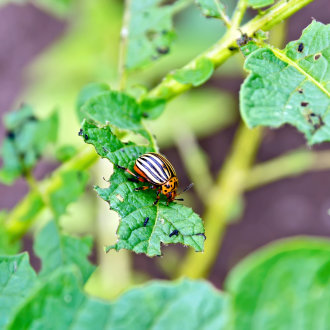
Short Answer: Grub damage that shows up on mid-Michigan lawns in August and September comes from eggs that adult beetles laid in late June and July. Preventive grub treatment applied in the last two weeks of June through mid July gets the product into the soil before the eggs hatch, which prevents almost all damage. Curative treatments applied in August work on younger grubs but are partial fixes at best and cannot undo damage already done. Late June through mid July timing is the single highest-leverage lawn intervention of the summer for Michigan properties.
If you have ever walked outside in late August or early September and found patches of your lawn lifting like loose carpet, with raccoons or skunks digging at the damaged areas, you saw grub damage that was decided weeks earlier in late June and early July. The lifecycle is consistent. The timing is predictable. And the right preventive treatment applied in the right week prevents almost all the damage that will otherwise show up two months later.
We want to walk through why June through mid July matters so much for East Lansing area lawns, what the lifecycle actually looks like, and what waiting too long actually costs.
The Lifecycle in Mid-Michigan
The grubs that damage Michigan lawns are the larvae of several beetle species, most commonly Japanese beetles, European chafers, and June beetles. All three follow similar lifecycles with slightly different timing.
Adult beetles emerge from the soil in late May and June. They feed on ornamental plants (Japanese beetles especially favor roses, linden trees, raspberries) and lay eggs in moist healthy turf. Egg-laying peaks in late June through mid July.
Eggs hatch into small white grubs 2 to 4 weeks after being laid. The young grubs begin feeding on grass roots immediately. Through August and early September, the grubs grow and feed more aggressively. This is when visible damage appears: yellowing patches that turn brown, grass lifting easily because the roots have been chewed away, and wildlife damage as raccoons and skunks tear up the turf hunting for grubs.
By late September the grubs are nearly full-sized and start burrowing deeper to overwinter. By October most are below the active feeding zone. Damage already done remains visible until surrounding healthy turf can refill or until the homeowner repairs the affected areas.
Why Late June Through Mid July Timing Wins
Preventive grub treatment applied in this window puts a granular insecticide in the soil where the eggs are being laid. The product is present in the soil when the eggs hatch and kills the grubs at the smallest, most vulnerable stage. Effectiveness is typically 90 to 95 percent.
Curative treatment applied in August works on grubs that have already hatched and are actively feeding. The grubs are larger, deeper in the soil, and have already done some damage. Effectiveness drops to 50 to 70 percent depending on product, timing, and conditions. Damage done before treatment remains.
The product cost difference is small ($90 to $150 for preventive vs $150 to $300 for curative). The result difference is large.
How to Know If Your Property Is at Risk
Several factors put a Michigan lawn at higher risk for grub damage.
History of grub damage. If your lawn had grub damage in any of the past 3 years, prevention is strongly recommended.
Healthy irrigated turf. Adult beetles prefer to lay eggs in moist healthy soil. The best-maintained lawns are often the highest-risk targets.
Neighborhood pressure. If multiple homes on your block had visible grub damage last year, the adult beetle population in your area is high.
Visible adult beetle activity. Japanese beetles on roses or linden trees, European chafer clouds at dusk in late June, June beetles at porch lights at night.
Newer subdivisions. New construction lawns with thin healthy irrigated turf are particularly attractive to egg-laying beetles.
What a Preventive Treatment Visit Looks Like
The visit takes 30 to 45 minutes for a typical residential lot. A granular preventive product is applied across the lawn at the labeled rate, with extra attention to high-risk areas. The product gets watered in immediately, either by us during the visit or by the homeowner within 24 hours.
The product residual carries through the egg-hatching window (about 8 to 12 weeks of active control). After that, the product breaks down naturally.
The Cost Comparison
Preventive treatment for a typical East Lansing area lot: $90 to $150 for a single application that handles the entire grub generation.
Curative treatment if you wait: $150 to $300 for a single application, often requiring follow-up 3 to 4 weeks later. Damage already done remains.
Replacement if damage is significant: $300 to $600 for small patches, $1,500 to $3,500 or more for substantial replacement. Plus the months of looking at brown patches while waiting for recovery.
The Beetle Trap Question
Bag-type Japanese beetle traps actively make problems worse on most residential properties. The pheromone lure attracts beetles from up to 300 feet away, and many of those beetles land on your plants before reaching the trap. University extension entomologists have recommended against residential bag traps for over a decade.
If you must use them, place at the back corner of the property far from any plants you want to protect.
Other Pests to Watch For This Summer
Grubs are the highest-stakes summer pest in Michigan but not the only one. Chinch bugs occasionally cause damage on stressed lawns, especially during drought. Sod webworm larvae feed at night and can produce thin yellowing patches. Bluegrass billbugs can damage Kentucky bluegrass in early summer with adult feeding signs that look like small yellow streaks. Each of these pests has different timing and treatment, so accurate identification matters. The general pattern across all of them is weekly observation, soap flush test when in doubt, and quick targeted treatment once confirmed.
What Damage Looks Like When You Skipped Prevention
For lawns that did not get preventive grub treatment, here is the timeline of what to expect. Late July: no visible damage yet but grubs are growing under the surface. Early August: first signs of thinning in irrigated areas, often subtle yellowing that looks like drought stress. Mid August: clear brown patches, grass lifting easily because roots are gone, often visible wildlife activity (raccoons, skunks, birds digging). September: patches connecting into larger zones if untreated, dead areas often a foot or more across in width. By October: cumulative damage often exceeds what can recover naturally, requiring sod replacement or extensive overseeding in fall. The contrast with properly treated lawns is dramatic.
Naturally-Based Options for Concerned Homeowners
For families concerned about the broader environmental impact of conventional grub control, naturally-based alternatives do exist but with caveats. Beneficial nematodes (microscopic parasitic worms) can reduce grub populations when applied at the right soil temperature with adequate moisture. Effectiveness varies and applications often need to be repeated. Milky spore disease (a bacterium specific to Japanese beetle grubs only, does not affect European chafers or June beetles) takes 2 to 3 years to build to effective levels in the soil. Both options can work as supplements to a conventional preventive treatment but rarely fully replace it. We can discuss which combination fits your goals and concerns during a property visit.
Frequently Asked Questions
How do I know if I had grub damage last year?
Signs include large brown patches in late summer that lifted like loose carpet when tugged, wildlife (raccoons, skunks, birds) digging in the lawn, and grass that did not recover even with proper watering.
What if I have already missed late June?
Mid to late July is still viable. After that, you transition to curative treatments in August and September, which are partial fixes. The window narrows fast.
Can I do this myself?
Yes. Granular preventive grub products are available at home improvement stores. The keys are correct timing, correct rate, and immediate watering.
How long does the protection last?
A single preventive application typically protects through 8 to 12 weeks of active control, which covers the entire egg-hatching and early grub-feeding window.
The Combined Lawn Care and Pest Management Calendar
For mid-Michigan homeowners running both lawn care and pest management programs, the integrated calendar produces the best results. April: spring fertilizer and pre-emergent, first mosquito-tick application. May: light fertilization, ongoing mosquito-tick. June: summer fertilizer with potassium, preventive grub treatment, ongoing mosquito-tick. July: brown patch monitoring, ongoing mosquito-tick. August: stress management, ongoing mosquito-tick. September: aeration and fall fertilizer, final mosquito-tick. October: winter pre-emergent and final feeding. November: final mosquito-tick if conditions warrant. Coordinated programs ensure each intervention reinforces the others.
What to Do Next
If you have not yet scheduled preventive grub treatment, the next 10 to 14 days is the right window in our area. We typically fill up by early July each year because the timing window is narrow and demand spikes.
Call us at 517-894-5792 or visit keastlawn.com. We serve East Lansing, Lansing, Okemos, Haslett, Williamston, Holt, DeWitt, and surrounding mid-Michigan communities.